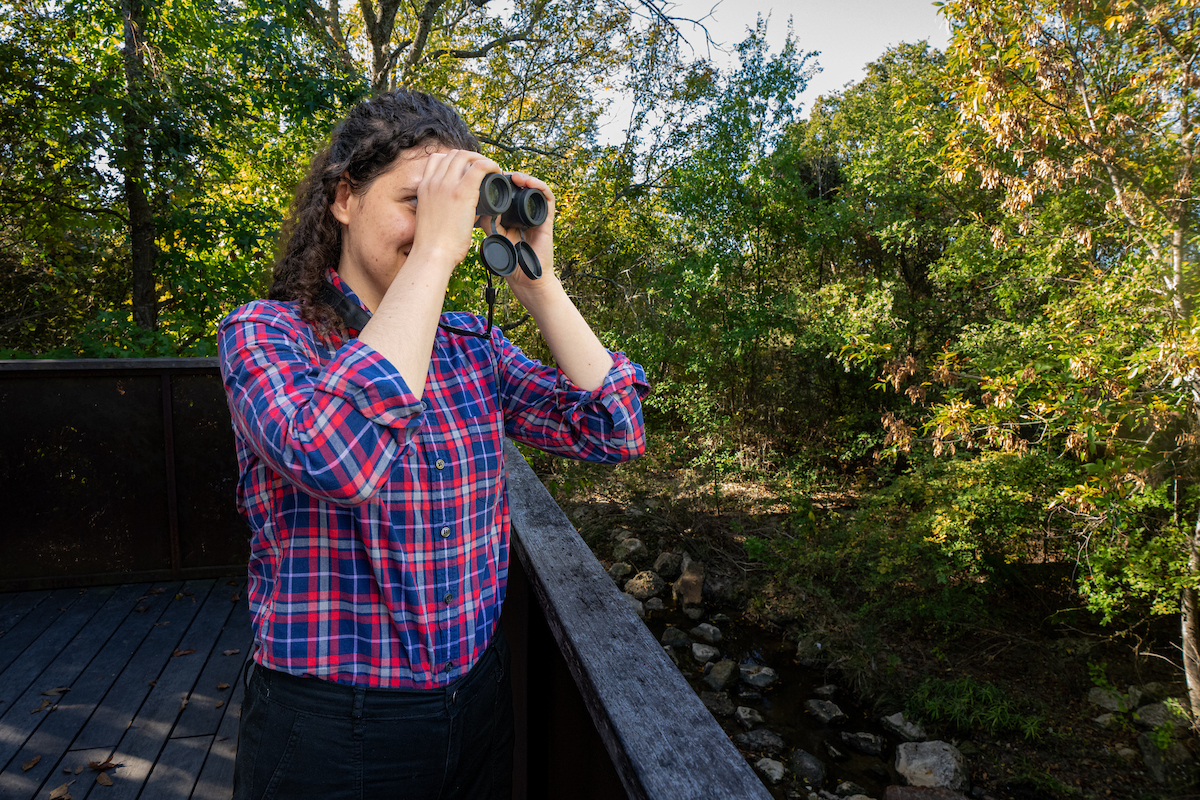
Texas A&M forestry track builds field-ready experts
Daniel Hook ’27 gains hands-on skills for careers in forestry industry
The forest resources track in the Texas A&M Department of Ecology and Conservation Biology is built to move students toward real career options on real acres.
Find Your Future in Forestry
Learn how to manage and protect our forests for future generations through Texas A&M’s SAF-accredited Forest Resources program.
When students complete the track, they can survey a patch of forest, sample, measure and identify the trees, then write a prescription for management of that land to fit the landowner’s timber or habitat goals and much more.
For Daniel Hook ’27, who grew up in Nacogdoches and spent many weekends wandering Davy Crockett National Forest, the forestry track was a natural path to a career outdoors.
“Spending a lot of time outside really helped me fall in love with nature,” he said. “I wanted to protect and conserve places like where I grew up.”
That desire to have nature as his office made the program’s blend of ecology and fieldwork the right fit.
“There are so many career options in forestry that it is hard to know exactly what to pursue,” he said. “The biggest advantage of this program is that it offers such a broad, comprehensive education that prepares you for whatever you decide to do after graduation.”

What forestry classes are all about
In the forestry track, learning moves outside early. Some of Hook’s favorite classes have been Forest Trees of North America, where he learned to identify tree species by walking among them, and Forest Ecology, where he began to understand how a forest develops and changes. He is eager for Forest Measurements, where students learn how to use the many tools and mathematical formulas necessary for forest management.
Hook’s field studies course last summer led to an experiential opportunity. Visiting professionals discussed forest inventories, analysis and restoration, fire as a management tool, geographic information systems, GIS, as well as timber mills and end products, before answering student questions.
Another project was focused on native grass restoration, not just timber, which fit his goal to be prepared for multiple career paths.
Working with Texas Native Seeds at the Plant Materials Center with the U.S. Department of Agriculture Natural Resource Conservation Service on common garden studies, he said they were able to study seed sources across the region and “we kept the best ones and built a stable seed source for native grasses and wildflowers.”
Hook said many of those seed mixes will be utilized by landowners and the Texas Department of Transportation for beautification and restoration projects.
“The forestry program really has everything a student could need and more: great scholarship opportunities, really great professors and a strong sense of community. I couldn’t imagine studying anything else or being anywhere else.”
Daniel Hook ’27
Texas A&M Forestry Resources Track Student
Community, service and momentum
Hook’s activities on campus also keep him connected to the industry. He has made strong connections as the treasurer of the Society of American Foresters, SAF, student chapter.
“We bring in people from all over the industry,” he said. “Weyerhaeuser comes every year and interviews for internships, so it is a good way to learn about jobs, network and maybe land an interview.”
Service keeps Hook and other students connected too.
“We plant with the Texas A&M Forest Service, give out saplings at “Trunk or Tree-t” and help with seed processing in the forest science lab,” he said. “I’ve made friends in the program, and it’s fun seeing it grow as people see how great the forestry track is here at Texas A&M.”
Where Hook is taking his forestry education

The program has given Hook what he needs for a successful career – mentors he can call, knowledge and field skills that set him apart on a resume, and a strong network through SAF. He is aiming for a role in habitat restoration and wants to work where his plans on paper become acres on the ground.
He said parents and prospective students often ask how the degree translates to a career. His answers reflect what he’s seen around him while in the program.
Graduates can become foresters or ecologists and step into timber planning, inventory, fire, restoration, analysis, public service or industry. Employers recognize and actively recruit Texas A&M students for the SAF accreditation, and the mix of field courses and instructor support makes the move to internships seamless. Scholarships in the track also help students stay focused on labs and fieldwork instead of finances.
Hook’s summary for students weighing their options is practical.
“The forestry program really has everything a student could need and more: great scholarship opportunities, really great professors and a strong sense of community,” he said. “I couldn’t imagine studying anything else or being anywhere else.”